European Commission · COM(2026) 345 final · Article 2
NOMOREWAR✳
✳ Terms & conditions. Protection shall not be granted to newly-arriving men aged 23–60 with military obligations under Ukrainian law who are not authorised to leave Ukraine.
Europe is about to shut fighting-age Ukrainian men out of the protection it gives their wives and children — sending them back toward the same war their families fled. Delete Article 2.
This campaign supports Ukraine's defence. It opposes Europe forcing men back.
What's happening
A single clause, buried in a renewal everyone supports.
On 26 June 2026 the Commission proposed extending protection for people fleeing Ukraine to 4 March 2028. Good. But inside it sits Article 2 — the clause that turns men away.
Temporary protection … shall not be granted to persons that are not in compliance with their military obligations as provided for in Ukrainian law, and for that reason are not authorised by Ukrainian authorities to leave Ukraine.— Article 2, COM(2026) 345 final · file 2026/0186(NLE)
What it means
A mother and her children flee the same missiles, the same city, the same war. They are let in. The husband is turned away.
He hasn't done anything. He isn't a soldier who ran from the front — he's a civilian who fled with his family. Turned away from protection, he doesn't vanish: he becomes undocumented in Europe, exposed to detention and return, or pushed back toward a country under daily bombardment.
The case against Article 2
Six reasons it's wrong.
It punishes people for being men
The clause falls on one sex, one nationality, one age band. Europe's Charter forbids discrimination by sex and nationality — and the proposal never justifies it. It just asserts it's fine.
It outsources protection to a foreign draft law
Whether you get EU protection would depend on whether Ukraine let you leave. Europe would turn another state's mobilisation rules into a filter on its own human rights.
It sends men back toward war
Denying the safe, legal route doesn't keep anyone safe. It leaves return, detention, or life in the shadows — against Europe's most basic rule: don't send people back into danger.
It splits families at the door
Protect the wife and children; turn away the husband and father. Temporary protection was designed to keep families together. Article 2 pulls them apart.
The timing is a trick
Rushing in the exclusion while postponing every protective part until 2027 is the opposite of fair, careful lawmaking.
Nobody has shown it works
No evidence that refuge in Europe changes Ukraine's mobilisation, and no look at gentler alternatives. A measure that removes rights must be proven necessary — not asserted.
Honest answers
"But what about…?"
"Ukraine needs its men to defend itself."
"Lots of governments asked for this."
"It's only newcomers — people already here keep their status."
"They can still claim asylum."
"Aren't these just deserters dodging the fight?"
Who actually asked for this?
"Strong support"? Show me.
The Commission says Article 2 was requested by "several member states." No official document names them. The lists that exist come from the press — and they contradict each other. The one origin actually on the record is Kyiv. Here is everyone genuinely on the record.
 European Commission Audiovisual Service · © European Union 2024 · CC BY 4.0
“This is something the Ukrainians asked us to do.”
 Stefan Brending / User:2eight · CC BY-SA 3.0 DE · Wikimedia Commons
“…dass wir die Massenzustromrichtlinie verlängern wollen, dass wir aber Zweifel haben, dass Ukrainer im wehrpflichtigen Alter darunter zu sehen sind.”
…that we want to extend the Mass Influx Directive, but that we have doubts as to whether Ukrainians of conscription age should fall under it.
 Karl Gruber · CC BY 3.0 AT · Wikimedia Commons
“Aus österreichischer Sicht soll es keinen automatischen Schutzstatus für aus der Ukraine kommende wehrpflichtige Männer mehr geben.”
From an Austrian perspective, there should no longer be an automatic protection status for conscription-liable men coming from Ukraine.
 politik.in2pic.com · CC BY-SA 3.0 · Wikimedia Commons
“It is essential for us to provide Ukrainians with protection, but at the same time the war needs to be fought and won. For that to happen, it is essential that more men stay in Ukraine and fight.”
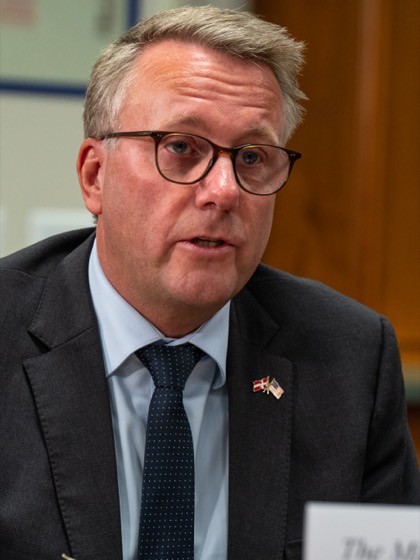 U.S. Secretary of Defense · CC BY 2.0 · Wikimedia Commons
“…det er ikke meningen, at vores opholdsregler skal bruges til at undgå mobiliseringen til det ukrainske forsvar.”
…our residence rules are not meant to be used to avoid mobilisation into the Ukrainian defence.
"Requested by several member states" — reported, never officially named. The press lists conflict:
Poland appears as a "supporter" in some lists — yet its one named minister is on record opposing a related curb. Politico's fuller list is paywalled and unverifiable.
The ask
Two petitions, one ask: an official petition to the European Parliament's Committee on Petitions (PETI), and a public petition for volume. Links go live at launch.
Three things that move it
The decision is being made quietly. Noise is the point.
Sign & share
Sign both petitions and pass this on. The Council vote has no public reading — visibility is the pressure.
Message your government
One line to your country's EU representation: "Delete Article 2 — same war, same refuge — don't split families."
Contact your MEP
Ask them to raise Article 2 and back the petition. Sympathetic MEPs can force it onto the record.
Where you live changes what helps most. The decision is a Council vote by qualified majority; a small group of governments can block it. Routing is biased by the blocking-minority arithmetic: a few pivotal governments can block Article 2. Contacting government is highest-leverage in the swing states; elsewhere, sharing and MEP contact carry more.